Humanthentic

Staying human in a digitally dominated world.

A plain metal ring that proves a real person is present, is the same person who was enrolled, and has stayed present ever since.

A DOOR AN ACCOUNT A PAYMENT AN AGREEMENT AN EXCHANGE A DEVICE YOUR IDENTITY STAYS INSIDE WHAT CROSSES THE LINE IS A SIGNED YES, NOTHING ELSE
The ring proves that a verified person is present. It does not tell the door, the bank or the counterparty who you are.

The problem

Every credential we use can be farmed, faked or replayed

A password proves knowledge. A card proves possession. A fingerprint proves that a finger was presented once, at a moment already past. None of them prove that the person acting now is the real person who was authorised.

That gap is where account takeover, remote-access fraud, coerced transfers and mule accounts live. It is not a shortcoming of cryptography but of physics: nothing in the chain is measuring a body.

Humanthentic measures the body. A plain titanium ring reads two independent physical consequences of life at a single fingertip and keeps confirming that they agree. Its keys operate only while that agreement persists.

Take the ring off and the credential is not revoked. It stops existing.

The widening gap

Showing you are real and present while protecting what is most private

Faces, voices, documents and behaviour can all be generated on demand. Every remote check that rests on an artefact, whether an image, a recording or a stream, now rests on something a model can produce more cheaply than a person can.

Camera liveness tests answer one synthetic model with another model. That is an arms race, and it is fought on the attacker's ground.

A body is not an artefact. Two physical consequences of one heartbeat, read at one fingertip through a channel that has to be a human body, cannot be recorded, replayed or synthesised.

And as software agents come to act legitimately on people's behalf, the useful question stops being who holds the account. It becomes whether a real person approved this request.

The question is no longer who is at the keyboard. It is whether anyone is.

The market

The internet is filling up with automation

In April 2026 automated requests passed half of all web traffic on Cloudflare's network. By June the split stood at 57.5 per cent machines to 42.5 per cent people, some eighteen months ahead of Cloudflare's own forecast.

Share of all web requests, worldwide, June 2026 57.5%
Automated
People 42.5%
Within the United States 71.5%
of requests are automated
Malicious automation 40%
four requests in every ten
AI agent traffic, year on year 1,700% growth in one year

What becomes scarce there is not identity, which models manufacture cheaply. It is presence: a way for one person to show, at the moment of the request, that a body is behind it.

A verified person layer, for an internet without one.
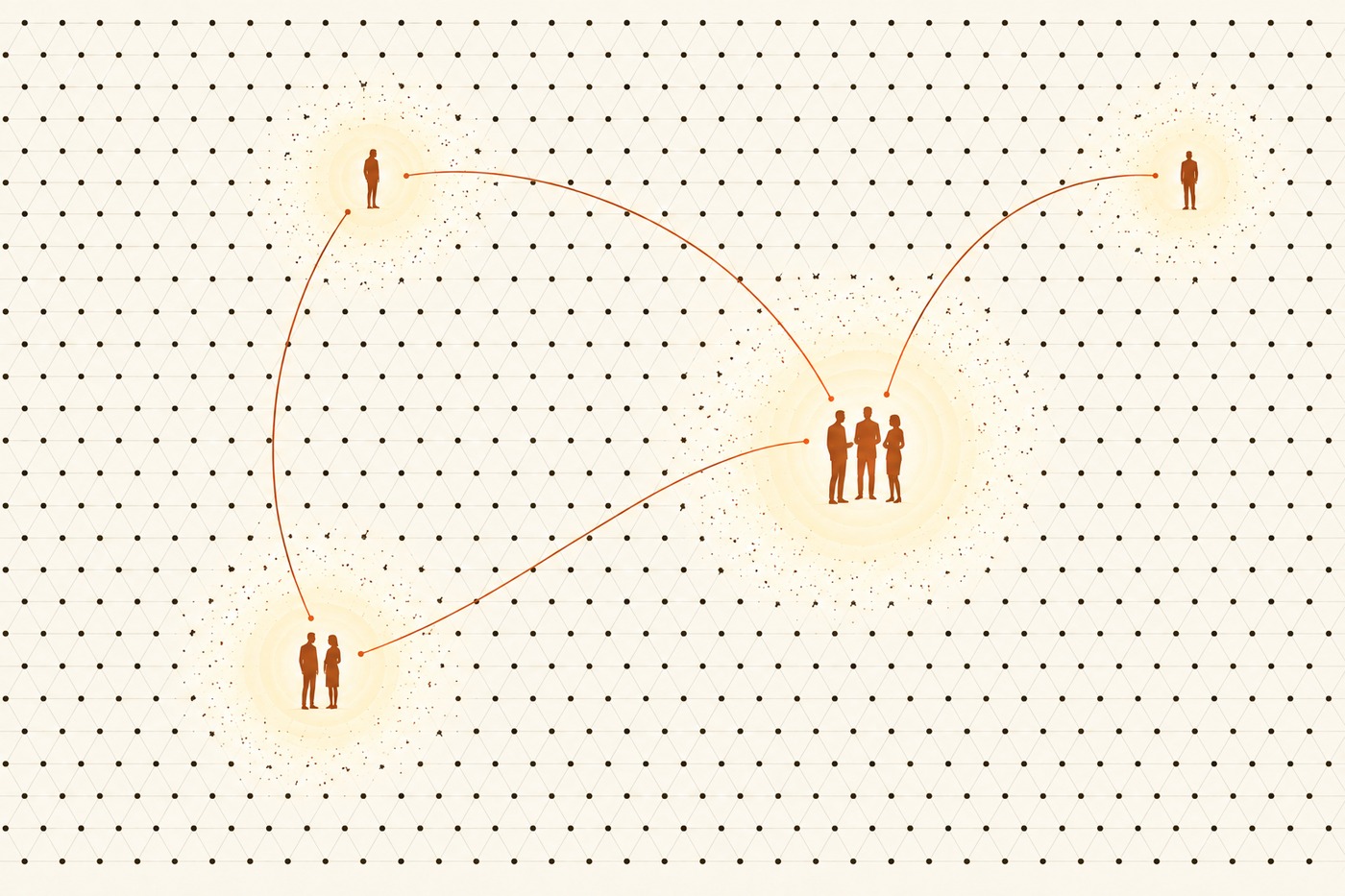
A dense lattice of machine nodes opening into warm clearings where people stand alone, in pairs and in small groups, joined to one another

Traffic split: Cloudflare Radar, June 2026, reported at Fast Company. Malicious share: Thales Bad Bot Report 2026. United States share and agent growth: Stack Futures.

The principle

Being human has to become an advantage, not a side show

The world asks for more of your data every year, in exchange for being believed. Documents, selfies, scans, behavioural histories. You surrender more of yourself each time, and none of it proves the one thing that matters: that you are here now.

Proof without disclosure

What a door, a bank or a counterparty receives is a signed confirmation that a verified person is present. Not your fingerprint, not your face, not your history. The proof leaves your hand; the data does not.

Easier for people, harder for machines

Every check built on artefacts gets harder for people and cheaper for attackers. A measurement of a living body inverts that. You touch something and it clears. Software cannot touch anything.

You should be able to navigate a data-demanding world without giving yourself away in it.

The asymmetry

One person, and everything trying to be them

Manufactured by software, in bulkBlocked
Credential stuffing, thousands per second
A stolen session token, replayed later
A deepfaked face on the video call
A cloned voice on the telephone
A synthesised identity document
A captured fingerprint, presented again
Remote access to the real device
An automated account farm
An agent acting beyond its authority
Physical measurement
A person, present, wearing the ring Clears

Everything above the amber line can be manufactured by software, in bulk, and gets cheaper every quarter. None of it involves a person at all. The line itself cannot be manufactured at any price, because what it crosses is not a policy or a password but a measurement of a body.

01 · Body recognition

Two measurements of one heartbeat, at one fingertip

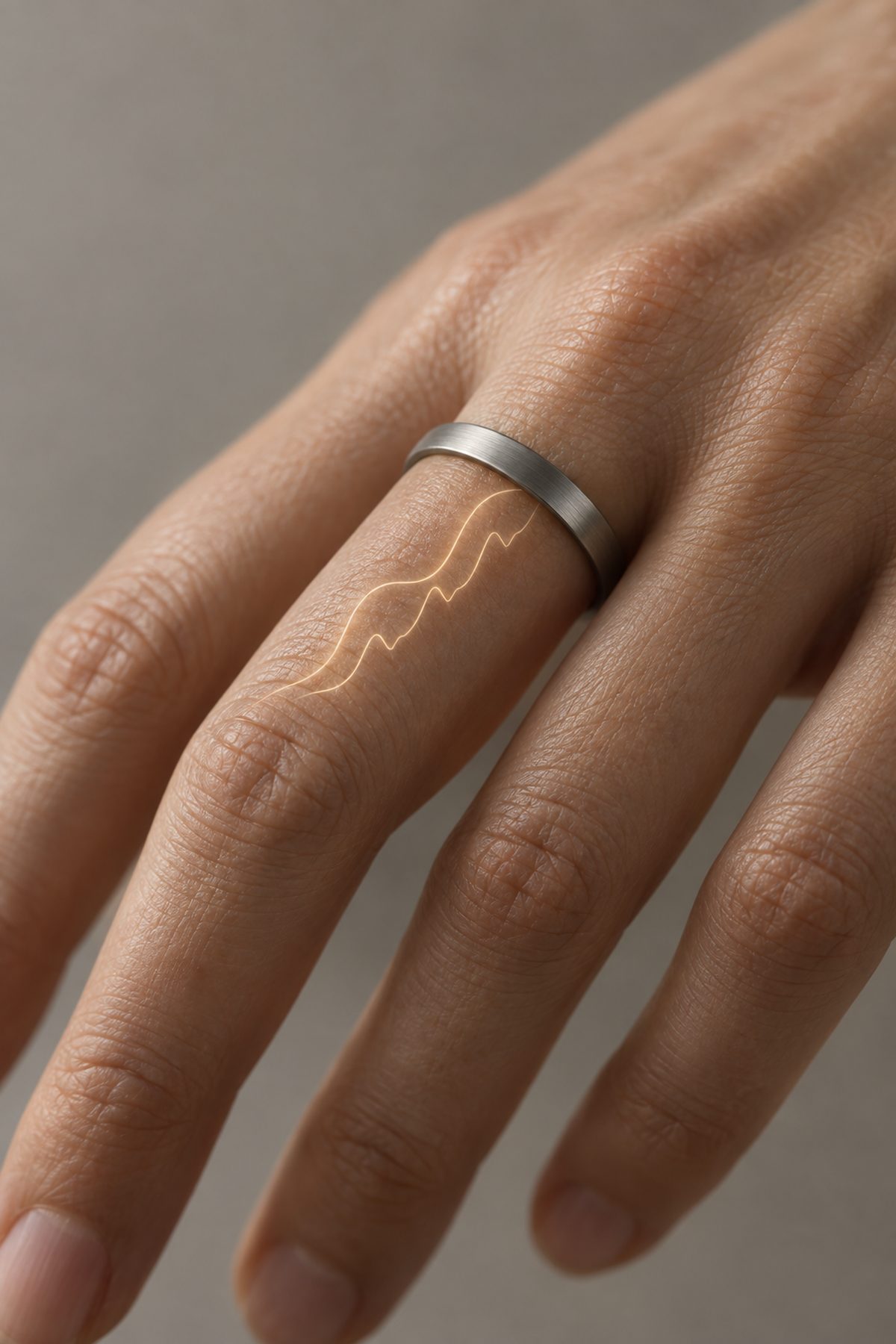
Beneath the band the ring reads an electrical property of the tissue and, separately, the mechanical recoil of the same pulse: two transductions in different physical domains, of one physiological event, at one site.

A human body produces both, in step, at a rate and phase that hold together within measurable tolerances. A cast, a film, a warmed replica or a recording produces at most one of them, and never both in agreement.

Agreement alone would be a single check at a single instant. Humanthentic treats the persistence of that agreement as the credential itself. The moment it lapses, the secure element stops signing.

Two signal traces rising and falling in step, read at one fingertip
The two signals, in step, at one digit.

The negative case

Off the finger, it is an ornament

There is no stored session to steal, no token to lift and no window of validity to exploit. A ring that has been removed, handed to someone else, or presented with an artefact in place of a real finger produces no signature at all.

Nor does it guess. Where the measurement is ambiguous rather than clearly absent, the ring returns an indeterminate state and declines to decide.

The ring lying still and unlit, producing nothing

02 · Single-person clearance

One touch, and doors know enough to open but not everything about you

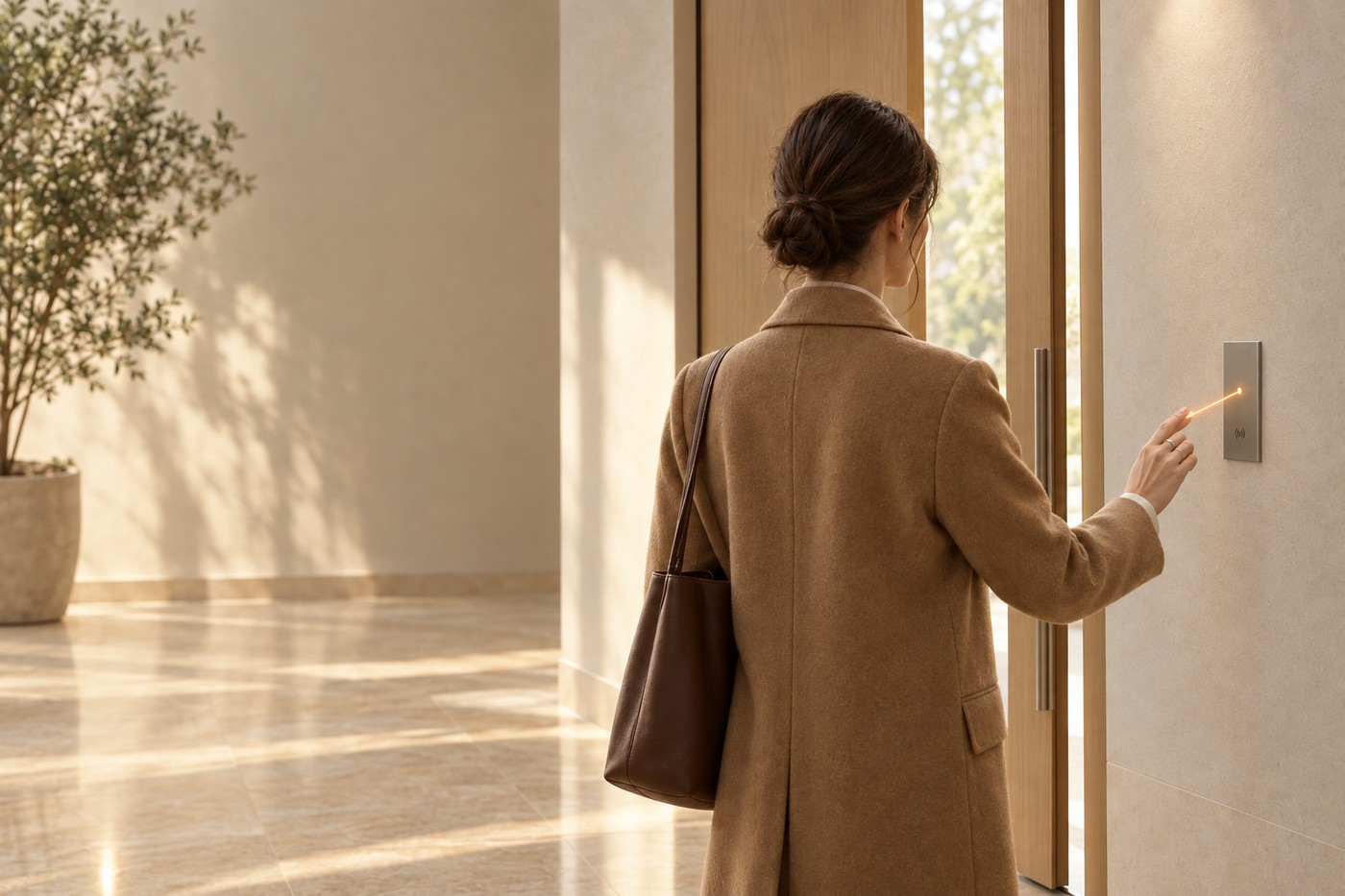
To clear a door, a terminal or a machine, the wearer simply touches it. The proof travels the last few centimetres through the finger itself.

That short distance is the security. A radio credential can be relayed from across a room. A contact channel cannot be relayed without a physical path through a body, and the reader tells true contact from mere nearness by the electrical signature of the contact itself.

What the reader receives is therefore not simply a key, but a key accompanied by evidence that the hand presenting it belongs to the person who was enrolled.

A woman in a camel coat touching a reader plate beside a door in a sunlit lobby

03 · Agreement between two people

The handshake becomes the signature

Where two parties must both assent, the assent is the physical act. Palm meets palm, both rings confirm continuous wear by both people, and a joint authorisation is produced.

Neither party could have produced it alone, and neither could have produced it at a distance. Nothing needs to be read aloud, typed, or countersigned afterwards.

Two hands clasped, each wearing a plain ring

04 · Multi-person clearance

A quorum that has to be in the room

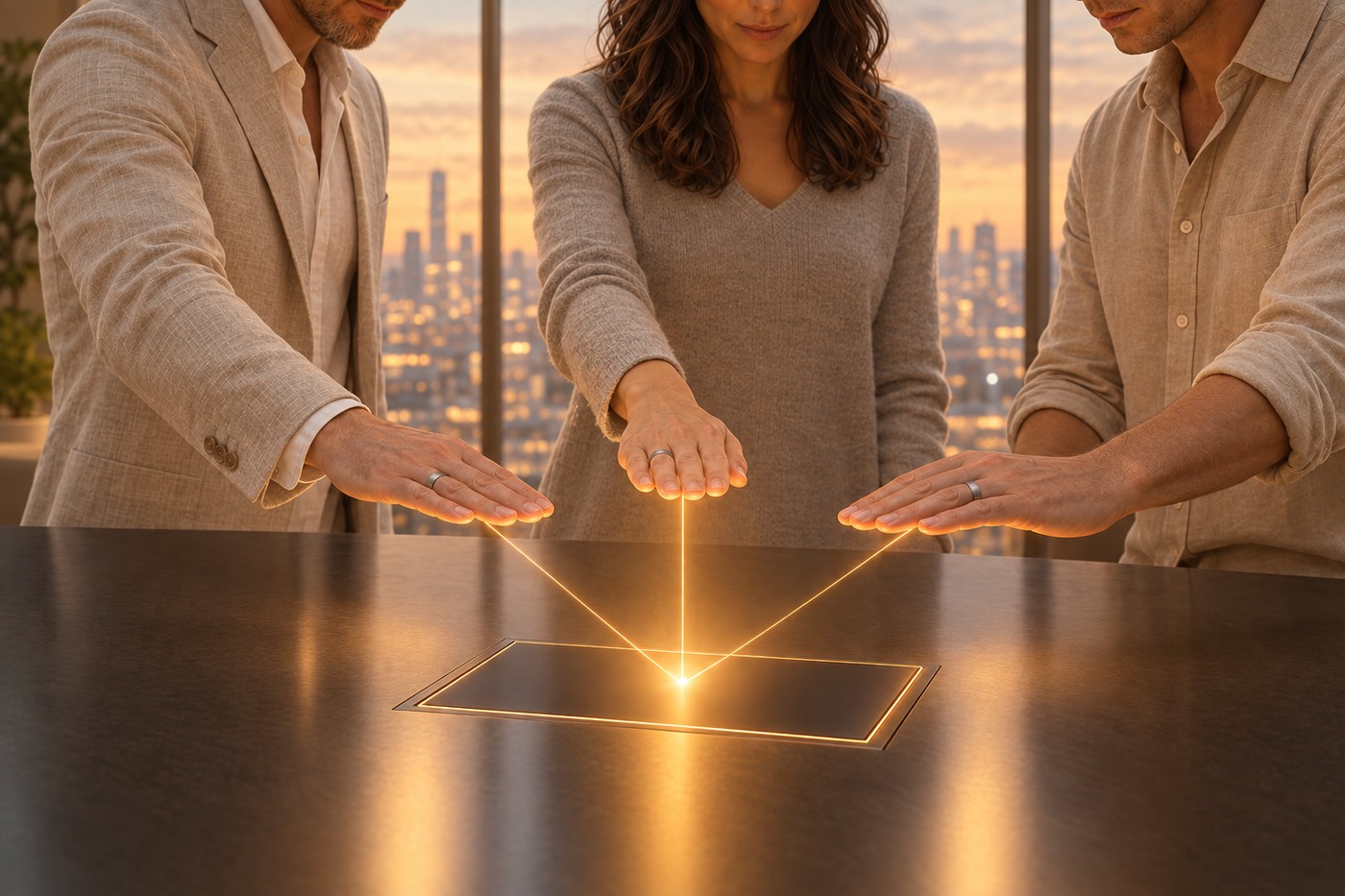
Three of five directors. Two of three custodians. Any threshold can be required, and the threshold is convened by physical contact between the people themselves.

Each ring contributes its share only while verifiably worn by its own wearer. The shares combine along the chain of contact, so the authorisation exists only while the group is genuinely touching.

Break the chain and the authorisation is not suspended. It never completes. Coercing one signatory remotely achieves nothing, because a quorum cannot be assembled by anyone who is not in the room.

Three people in light clothing holding their hands above a contact terminal set into a table, three lines of light meeting at a single point

05 · Enrolment and self-custody

Your biometric data is yours, and the ring is the only place it is stored

At enrolment the biometric is captured while the ring stays worn, and the ring measures the channel through the very hand being presented. That establishes something no scanner can establish on its own: that the biometric came from the body the ring is on.

The template is written into the ring's secure element and held nowhere else: no central store to breach, no database to subpoena, no copy of you held by anyone else. And, uniquely, proof of whose body it came from.

Enrolment is the last time anyone needs a copy of you. From then on the ring answers for you, and the answer is a signature.

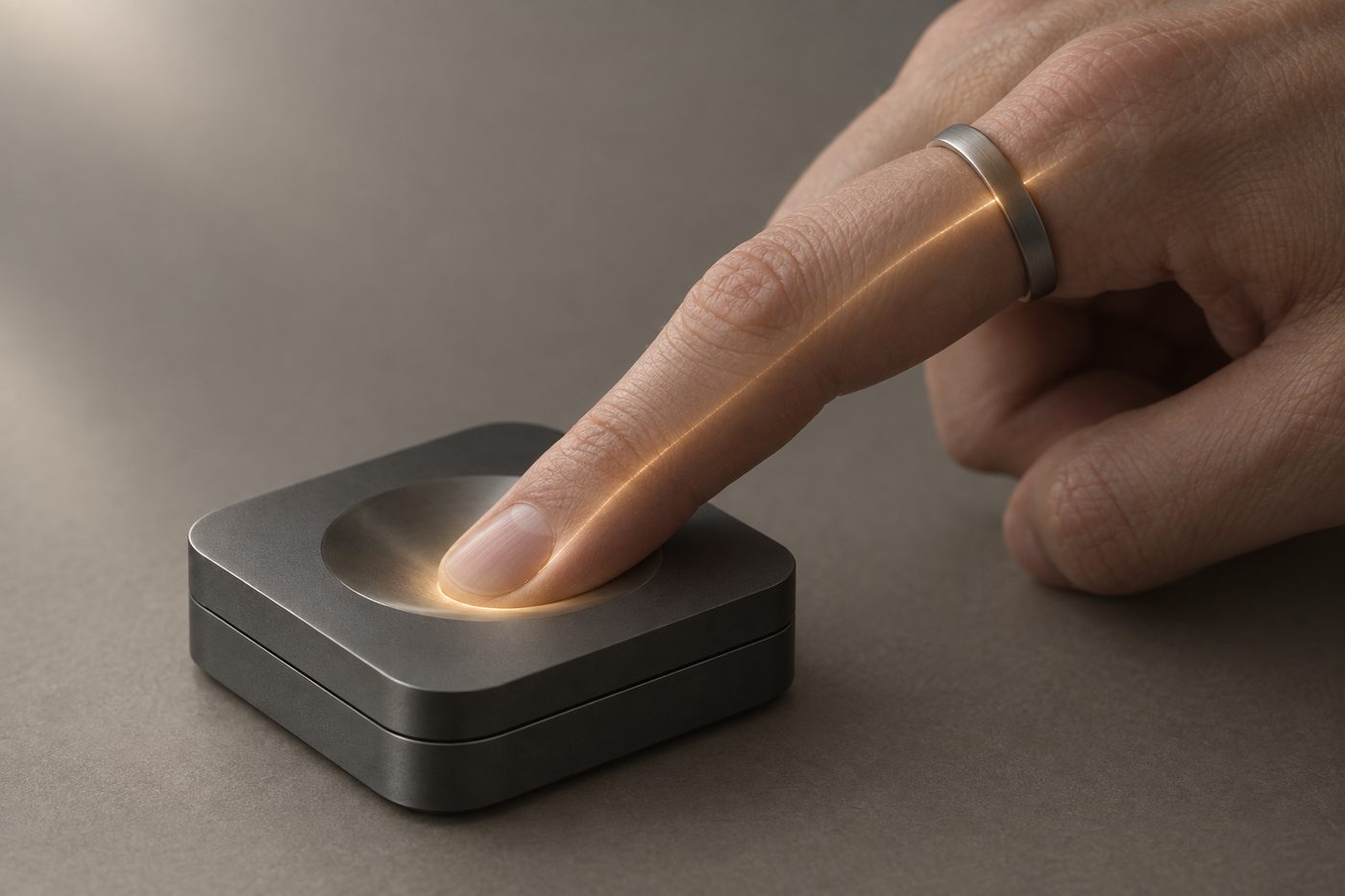
A ringed finger on a phone's fingerprint sensor during enrolment

06 · Exchange and account access

Know your customer once. Then bind every approval to them.

Identity documents are checked at onboarding, as they must be. From then on every login, withdrawal and approval can be bound to the same person who passed that check, and not to a device, a session or a password.

The phone performs the identity step with its own certified sensor. The ring proves that the finger which performed it belongs to the body wearing the ring. The challenge arrives by radio; the answer returns through the hand.

Every approval needs a living hand at the device. A remote attacker does not have one.

An approval on a phone screen confirmed by a ringed hand

Architecture

Four layers, each covering what the others leave open

LayerMechanismWhat it settles
Identity
The phone's own certified fingerprint sensor, returning a hardware-attested result
Whether the device is in its owner's hands
Origin
The body-coupled channel, measured at the instant of capture
Whether the finger presented is a living one, and whose
Persistence
Two-signal consistency at one digit, sampled continuously
Whether the same person is still there a minute later
Proximity
The electrical signature that distinguishes true contact from nearness
Whether the contact is real, rather than merely near

Each layer is a physical measurement, so the answer rests on the body rather than on trust.

How it fits

A band of 8.0 mm by 2.6 mm, drawn to scale

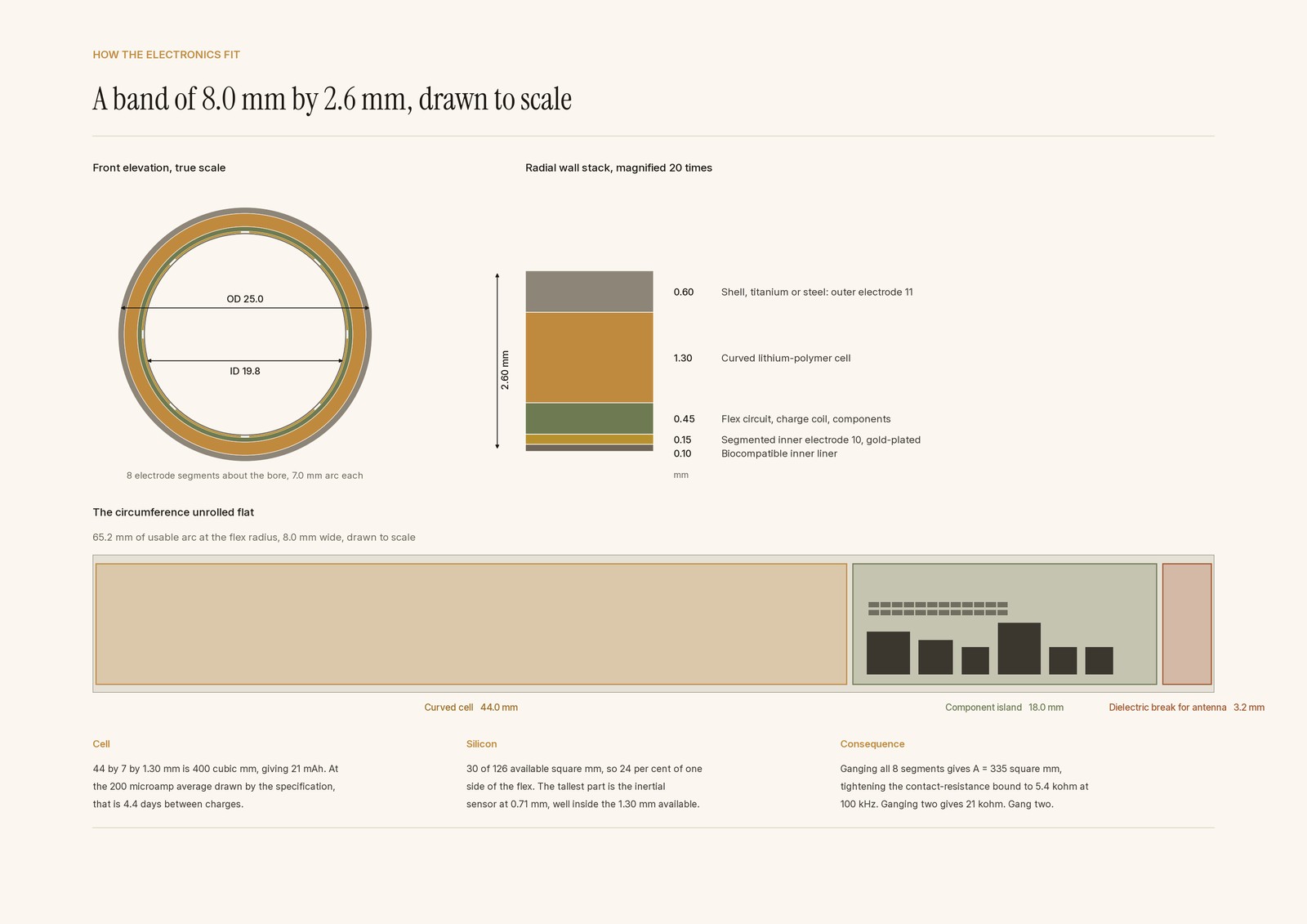
The ring has to look like a ring, so the geometry is fixed first and the electronics are made to fit inside it. A 25.0 mm outer diameter with a 19.8 mm bore leaves a 2.6 mm radial wall and 65.2 mm of usable arc. Everything the specification requires sits inside that wall: eight gold-plated electrode segments about the bore, a 0.45 mm flex circuit carrying the charge coil and silicon, a 1.30 mm curved lithium-polymer cell of 21 mAh, and a 0.60 mm outer shell of titanium or steel which doubles as the outer electrode.

The silicon occupies 30 of the 126 square millimetres available on one side of the flex, and the tallest part, the inertial sensor at 0.71 mm, clears the 1.30 mm available. At a 200 microamp average the cell gives about 4.4 days between charges. So at 8.0 mm wide it can genuinely be a plain band, with roughly a quarter of the board area still unused. Below about 7 mm the cell, not the silicon, runs out first.

Scale drawing of the ring wall showing the electrode, flex circuit, cell and outer shell
Front elevation at true scale, the radial wall stack magnified twenty times, and the circumference unrolled flat.

Position

Where the invention stands

Four things distinguish the approach: verified continuous wear rather than a single check, the physical discrimination of true contact from mere nearness, multi-party authorisation convened by bodily contact, and device-held biometric templates whose bodily origin is proved. The invention is the subject of Irish patent application no. 2026/0418, filed 18 September 2026.

The ring is deliberately plain. It carries no display and no visible electronics, because the proposition is not a wearable computer. It is a measurement instrument that happens to be jewellery.

Get in touch